
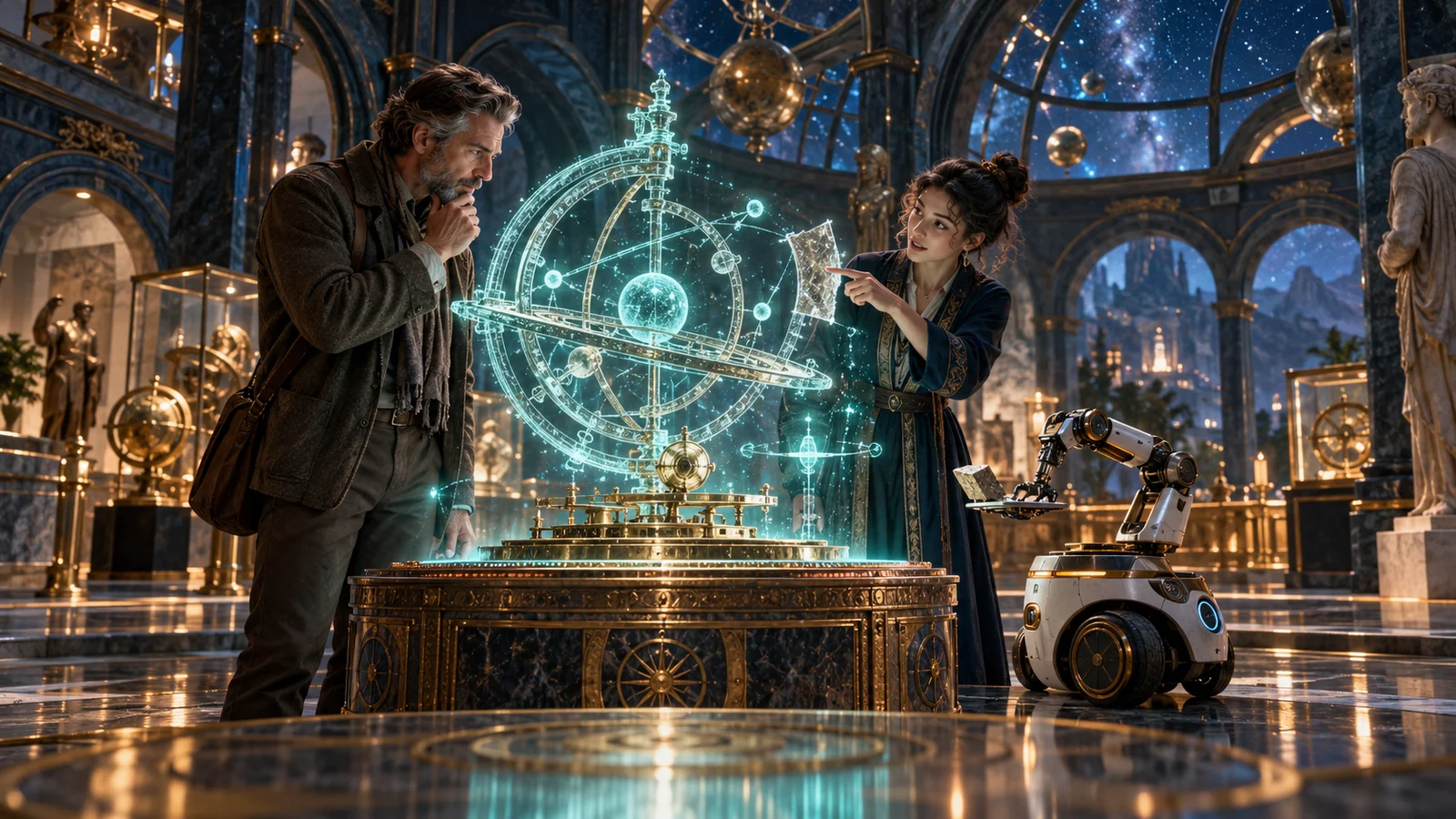
QUANIA · Future Scenarios Laboratory
Utopia Horizon
Change one condition. Trace the outcome.
How could a fairer world work? Consider water, work, knowledge and decision-making together. Here QUANIA is a shared design inquiry: consulting evidence, testing alternatives and making our mistakes visible.
Explore a city’s water supply in 2076 and how people work with AI in 2126. Test phase in a two-qubit circuit, then investigate the source of a radio trace at the observatory.
Scenario diagram and its limits
Holographic light show
Rehearsing the future
The route water takes
In the 2076 scenario, light carries water towards a coastal city. Which district gets it first depends on decisions made along the way.
Possibility Table · 01
Who will safeguard the city’s water in 2076?
After a dry spell, a coastal city invests in its water system. Try two decisions under the same conditions. What might the city gain by reducing water losses or by producing fresh water from the sea?
This is a thought experiment. The results show how your assumptions affect the trade-offs. Capacity, costs and probabilities would require local data.
Shared conditions
What each decision changes
Repair the network
Measure water losses. Prioritise pipes with the worst leaks and neighbourhoods with the poorest service.
- Water supply
- Water saved through repairs can provide a buffer during one dry season.
- Energy and operations
- The existing pumps keep running. Leak detection, pipe repairs and ongoing maintenance shape the workload.
- Household access
- Prioritising underserved neighbourhoods can improve basic access alongside system-wide repairs.
What observation would change your decision?
Reconsider if measured leakage is smaller than expected or rises again after repairs.
Add a source from the sea
Use reverse osmosis to desalinate seawater. Plan for power and the concentrated brine that remains.
- Water supply
- An operating plant can supplement rainfall-dependent sources. Build time and operating capacity matter.
- Energy and operations
- High-pressure pumps and membrane upkeep carry recurring costs. Discharge requires marine monitoring.
- Household access
- A basic supply guarantee and tariff support can help the new source reach low-income households.
What observation would change your decision?
Reconsider if outage logs, measured power use or marine monitoring exceed the design assumptions.
Decision Traces · 02
How do you learn a profession in 2126?
In a fictional city office, an AI system reads requests for services and proposes a decision. Compare two ways of handling the same request. In one, the system processes routine cases. In the other, a staff member reviews the file before a decision.
This is a thought experiment set in 2126. Today’s studies measure particular workplaces and tasks. They do not determine future jobs or the size of these effects.
Shared conditions
What each workflow changes
Automate routine decisions
The system decides routine cases. Staff handle exceptions and audit a sample afterwards.
- Learning the profession
- Supervised practice lets new staff try basic tasks usually handled by the system.
- Errors and service time
- Staff can audit sample decisions afterwards. An error can already affect someone before it is detected.
- Appeals and accountability
- A person can reach a reviewer outside the automated workflow that made the decision.
What observation would change your decision?
Include repeat requests and corrected decisions. If total resolution time stays the same, the first response is an incomplete measure.
Review before deciding
The system proposes a decision. A staff member checks the evidence and records a reasoned decision.
- Learning the profession
- New staff can compare the recommendation with the record and discuss its reasoning with a colleague.
- Errors and service time
- Someone who can check the source can change the recommendation before it affects the service decision.
- Appeals and accountability
- A second reviewer can compare the original reasoning with new evidence from the applicant.
What observation would change your decision?
If longer review catches fewer errors in sample cases, investigate which part of the review is failing.
Quantum Laboratory · 03
Same odds, different phase
Two qubits start in the zero state. Choose an experiment or add gates in order. Then measure along Z, X or Y. Compare which results are possible with how often they appear in a set of trials.
An ideal quantum circuit simulated on a classical browser. The model uses neither a physical quantum processor nor device noise.
What do the gates do?
- H
- Starting from |0⟩ or |1⟩, it makes the two Z outcomes equally likely. Applying H again undoes it.
- X
- Swaps the |0⟩ and |1⟩ states.
- Z
- Flips the sign of the |1⟩ component.
- S
- Adds a quarter turn to the phase of the |1⟩ component.
- T
- Adds an eighth of a turn to the phase of the |1⟩ component.
- CX
- Applies X to the other qubit in components where the control qubit is |1⟩.
Gate sequence
- Hq0
- Zq0
- Hq0
X 0Y 0Z -1
The vector describes q₀ alone. In this ideal two-qubit circuit, a shorter vector indicates entanglement with the other qubit.
Measurement results
Result order is q₀, q₁. Each trial prepares the same circuit from scratch. Counts can vary in a small sample.
| q₀q₁ | Probability | Count in 128 trials |
|---|---|---|
| 00 | 0% | — |
| 01 | 0% | — |
| 10 | 100% | — |
| 11 | 0% | — |
00 0% · 01 0% · 10 100% · 11 0%
Show the OpenQASM 3 circuit
OPENQASM 3.0;
include "stdgates.inc";
qubit[2] q;
bit[2] c;
h q[0];
z q[0];
h q[0];
c[1] = measure q[0];
c[0] = measure q[1];
Signal Room · 04
You found a trace. Where did it come from?
Three files await in the observatory archive. Point the telescope away, return to the target, then consult a second observatory. Find out which checks distinguish traces that look alike at first.
All readings in this room use synthetic training data. The exercise includes neither a real sky discovery nor a live telescope connection.
Records examined · 1/4
The first observation was taken with the telescope pointing at the chosen target.
Trace above threshold
- Initial frequency channel
- -23
- Channels per time step
- 0.375
- Width in channels
- 1
- Mean power along track
- 4.152
Colour represents relative power. The program searches frequency slopes, averages the power along a track and applies a threshold chosen for the synthetic data. That threshold carries no statistical confidence level for real telescope data.
New close readings
What the scenarios rest on
Each dossier works through an example, a detail from the evidence and the limits of the conclusion it supports.
2076 · How do we read a water account?
A city may have abundant water over a year and still experience summer outages in some districts. Total supply does not tell us where or when people can access it.
Look closely at the evidence
Separate supply, leakage, demand and reserves for dry periods. Compare repairs and new capacity under one budget, then check the driest week and the least-served district.
What can we conclude?
The IPCC assesses observations and scenarios. QUANIA’s 2076 city is a worked example. A real city needs network and catchment data.
How could a district’s risk of running dry fall while the annual average stays unchanged?
Show the answer
Distribution and storage can change. A dry-period reserve or lower losses in the district can prevent outages without raising the annual total.
2126 · A task is different from a job
An occupation contains tasks affected in different ways by the same tool. Drafting a form may become faster. Explaining and correcting a wrong form can still take time.
Look closely at the evidence
The ILO study estimates exposure of tasks to generative AI. In your scenario, put tasks, decision authority and training needs in separate columns. Ask who gets the time that is saved.
What can we conclude?
Exposure does not predict job losses. Infrastructure, bargaining, organisational rules and the nature of the work can change outcomes.
If preparation speeds up but review takes longer, whose productivity has changed?
Show the answer
Preparation time can fall while the reviewer’s work grows. Measure total time, errors and correction effort across both tasks.
When do we rule out a signal?
BLC1 was a narrowband signal of interest observed in the direction of Proxima Centauri. An interesting pattern can warrant investigation before its source is known.
Look closely at the evidence
The team compared signals with similar features and the conditions in which they appeared. It concluded that BLC1 was consistent with terrestrial interference. Finding related features in other records mattered to the explanation.
What can we conclude?
This study explains why one candidate was ruled out. It does not settle the wider search. New candidates need to be examined on their own evidence.
What independent observation would you request to test a pattern seen once?
Show the answer
Ask to observe the same direction with a different receiver and compare with off-target recordings. An independent repeat makes a shared instrument fault less likely.
Research drafts
An open notebook for the future
Designing a world starts with asking who can live well, and under which conditions. These proposals consider basic needs, freedom and shared creation together.
50 initial projects · 17 new design directions · 3 extensions
These are proposals, not working products, implemented public systems or delivery promises. The proposed first experiments have not been conducted. 2126 and 2176 are research horizons, not deadlines. Sources support existing components and methods; they do not validate the complete QUANIA proposal.
The full research dossiers are currently available in Turkish. The four teaching labs and the close readings above are available in English.
Read the Turkish research originals