Let an object spark your curiosity. Let a question challenge what you know. Let a discovery touch your life.
These discoveries are open to everyone. Bring your curiosity.
The living museum of the future
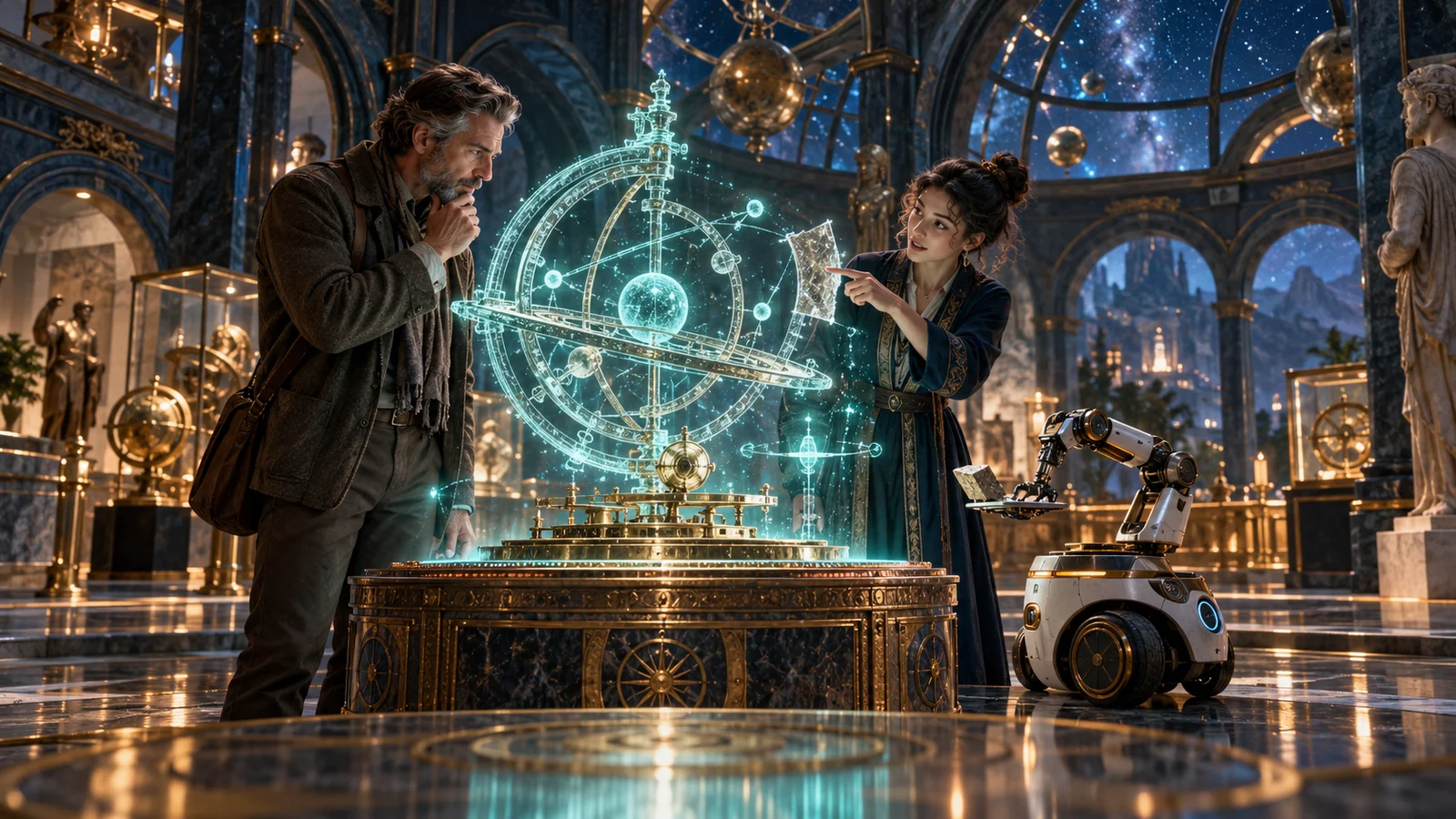
AI-assisted future concept. An imagined living museum where people retain decision authority and a robot assists. Artistic future concept, not a claim about an existing technology or completed museum.
FIRST STOP · CURIOSITY
Choose a door. An idea is waiting inside.
First, a small encounter. Then the deeper story of the object, the evidence and the idea.
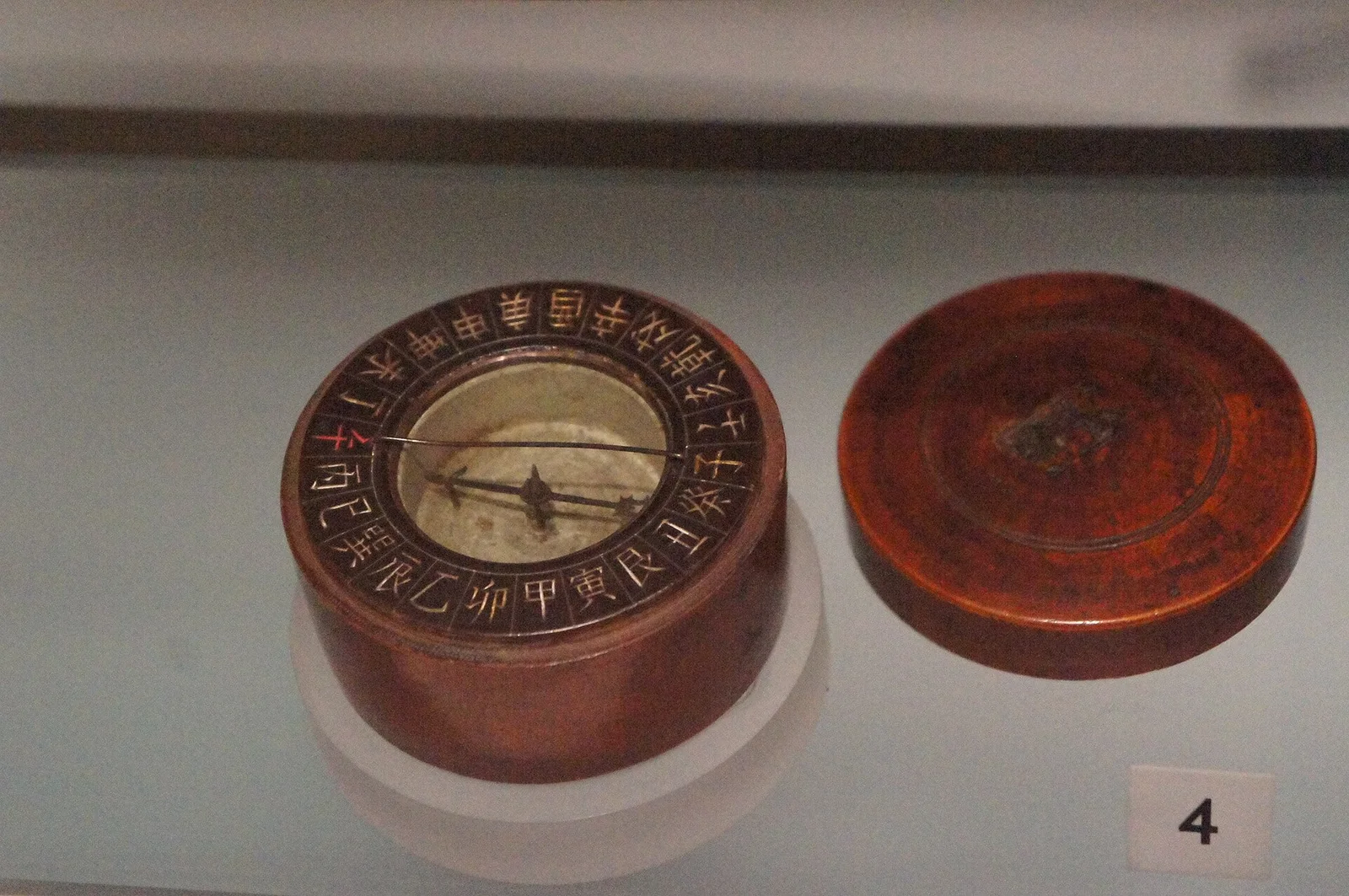
Chinese mariner’s compass, circa 1760 · National Maritime Museum. Photograph of a historical object.
Visual gallery · the curator’s pathObservation journey · from stone to stars
THE OBSERVATION JOURNEY OF CURIOSITY
I
GöbeklitepeAncient Threshold / Stone Monolith
“When did we decide to look at the sky and record ourselves on stone?”
Monumental T-pillars built between 9600 and 8200 BCE invite questions about shared labour and symbolic life. Their use remains a matter of archaeological interpretation. They have not been established as an observatory.
“Can you measure the circumference of the Earth with only a shadow and steps?”
Eratosthenes estimated Earth’s circumference using the distance between Alexandria and Syene and the difference in solar angles. Spherical geometry, a distant Sun and distance information were parts of the reasoning. A shadow alone was not enough.
“How did we learn to trust a reality we cannot see?”
A curved piece of glass. The invisible atomic voids and infinite cosmic depths where the eye fails. We brought heaven and earth closer through bent pieces of glass. Does this lens reveal the hidden reality, or does it warp our gaze to create a new illusion?
IV
SamarkandSamarkand Astrolabe & Sextant
“How did we fix the positions of the stars with brass gears and giant sextants?”
Colossal stone sextants and brass astrolabes. A civilization putting coordinates of thousands of stars onto paper with millimetric precision. We bound the movements of stars to mathematical gears to calculate time and distance. The mechanized vault of heaven.
V
VoyagerCosmic Record in the Dark
“When our voice is lost in the darkness, who will hear us?”
A copper disc gold-plated drifting in the void. A cosmic message in a bottle casting humanity's voice, music, and loneliness toward unknown minds. Even when our star dies and we fall silent, the whispers on this record will keep spinning. Is this record a greeting to the universe, or a silent gravestone left in empty space?
VI
TodayOpen Horizon / Not Yet Written
“Where will we look next?”
Humanity's sky observation journey is not over. It aims not to propagate AI or technological achievements, but the philosophical core of the human urge to look up and give meaning to existence (Techne). The horizon is open.
◆
“Knowledge grows more from questions than from answers.”
— QUANIA
HEURISKA is a living museum of memory examining how humanity looks at itself through technology and the history of curiosity. It aims not to propagate AI or technological achievements, but the philosophical core of human tools (Techne).
Some artifacts here might be shining in the skies of AETHRA.
A TRIBUTE TO INVENTION
Al-Jazari’s workshop and fellow inventors
A hall where water measures time, a drawing becomes a machine and an unseen field creates motion. Al-Jazari is at its heart; Leonardo and Tesla follow different paths of inquiry.
HEURISKA · THE LIVING MEMORY OF INVENTION
Fifty stories. One curiosity.
From al-Jazari’s workshop to communication through light: each story opens a need, a mechanism and a question about human life. Follow makers, records and accumulated knowledge without turning invention into the legend of a solitary genius.
50CEZERÎ → ∞
50 / 50 stories
01
Ten doors into al-Jazari’s workshop
Elephant Clock · Time on stage
What if you watched time unfold instead of reading a dial?
Open the mechanism and story+
The idea at work
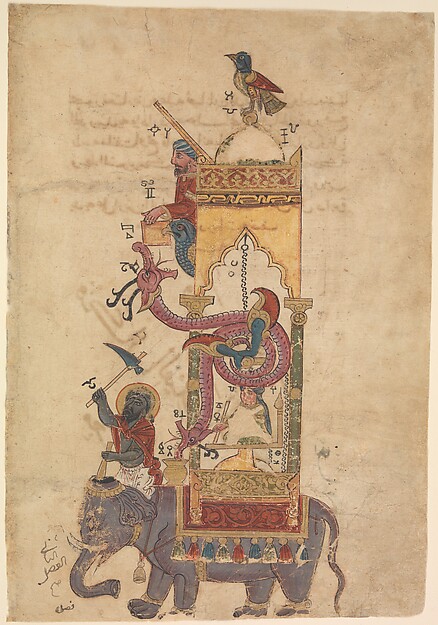
Al-Jazari’s elephant clock turns water-measured intervals into a performance of moving figures. Flow initiates a sequence rather than merely displaying a number. The museum leaf belongs to a later manuscript copy, not an original machine made in 1206.
A door into human life
The clock is both measurement and narrative. How people understand a technology is part of its design.
The castle clock makes time visible through doors, figures and a sequence of displays. One movement leads into another. Its story concerns the relationships from input to final signal, rather than one isolated gear.
A door into human life
Large systems become legible through the timing of small parts. Change the sequence and the meaning changes.
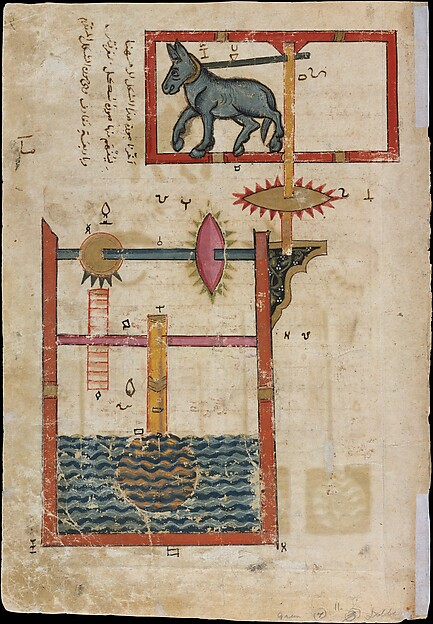
A Smithsonian manuscript leaf records a water clock with drummers from al-Jazari’s tradition. The end of an interval becomes a signal of figures and sound. Measurement reaches the ear as well as the eye.
A door into human life
Presenting information through different senses offers more than spectacle: it creates other ways to notice it.
How can a water vessel initiate a sequence of service?
Open the mechanism and story+
The idea at work
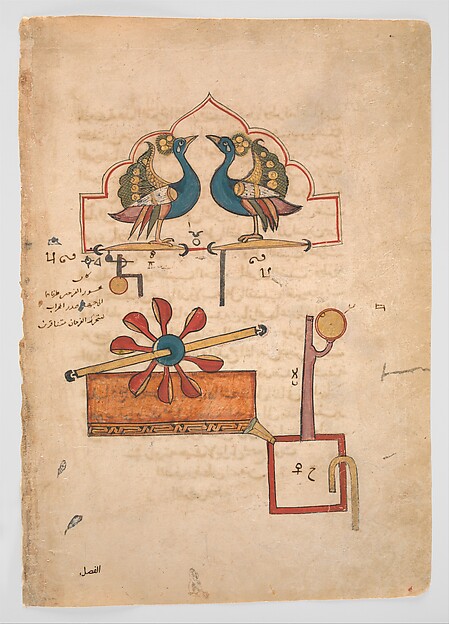
In the peacock handwashing device, used water raises floats below the basin. Their motion operates figures offering soap and a towel. An elegant vessel conceals a sequence controlled by changing liquid levels.
A door into human life
Noticing an everyday need can begin an invention. Design organises care as well as power.
How does slow water movement become a readable indication?
Open the mechanism and story+
The idea at work
Human-shaped indicators in al-Jazari’s clock tradition carry internal changes to the outside. A linkage connects the float’s position to a visible sign. We see an indication derived from flow, rather than time itself.
A door into human life
Every indicator translates. Ask how its visible sign relates to what it measures.
In a candle clock, burning material supplies the input for an indication. Changes in burning conditions can change its relation to time. Watching a candle and engineering a reliable clock are different tasks: regularity must be established.
A door into human life
An invention need not discover a new force; it can make an existing change readable.
These are original QUANIA learning narratives. Patents, manuscripts, museum objects and later models are different kinds of evidence. Mechanism explanations are not scale reconstructions or construction instructions.
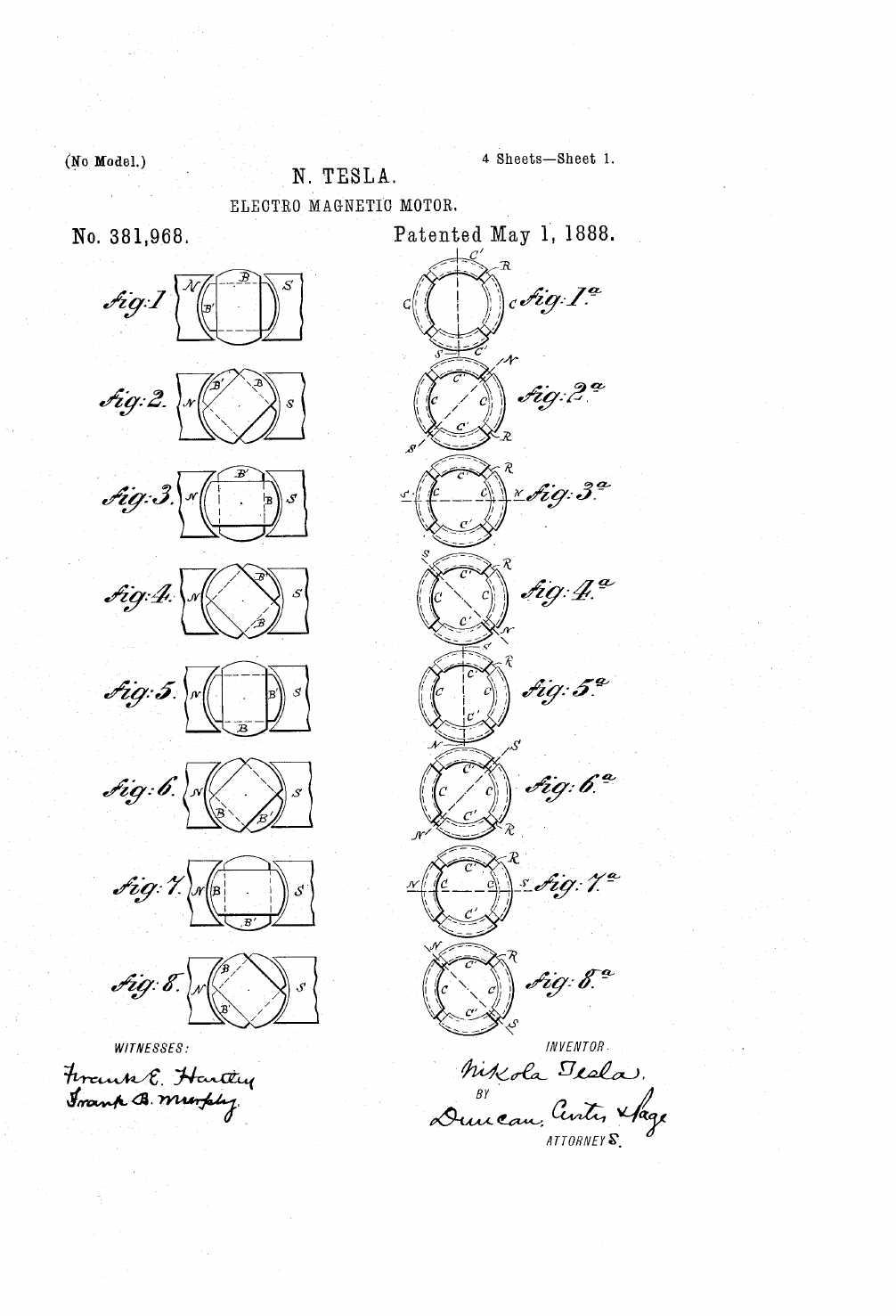
Look at the document, then return to the diagram. These leaves and the patent plate are historical records; our moving drawings are teaching interpretations.
A diagram explaining the principle, not a scale reconstruction or numerical physics model.
Liquid movement represents an interval; this vessel is not a scale copy of the historical clock.
1 / 4 · Measure an interval with water
01 / The Elephant Clock · reading a chain of motion
Al-Jazari: time told by water
What the record establishes
The Elephant Clock appears in al-Jazari’s 1206 mechanical treatise. Moving figures and sounds make half-hour intervals perceptible.
Open the deeper reading+
A QUANIA reading
The elephant’s appearance is only the beginning. One event initiates another: an interval measured with water leads to a signal and a reset. Reading the machine means asking where its energy comes from and which part triggers the next.
This teaching text is an original QUANIA explanation. Read it alongside the historical record and cited sources. The drawings are not scale reconstructions or physics simulations.
Begin with the terms
Water clock
A device relating a regular movement of liquid to elapsed time.
Trigger
A transition that starts another movement when a threshold is reached.
Reset
Preparing a mechanism to carry out its task again.
01
Begin with the problem, not the decoration.
Measuring an interval and announcing it are different tasks. Water might move inside a vessel, but if an observer cannot tell that an interval has ended, the clock is not yet readable to that person. We therefore examine the Elephant Clock as more than an ornate object. Measurement, linkage, a visible or audible signal and preparation for repetition belong together. Bringing these tasks into one machine is a valuable design lesson.
02
Ask a separate question at every link.
The first step in our diagram represents an interval; the second conveys the change to another part. The third concerns the observer’s signal, and the fourth prepares repetition. Every arrow needs more than “this happens next”: what connection makes it happen, where does motion come from, and what changes if a part sticks? These four steps do not calculate the historical machine’s complete mechanism or actual timing. They offer a way to investigate it.
03
Spectacle and reliability are complementary.
A moving figure attracts attention. A clock must also mark repeated intervals in a reasonably consistent way. A single successful movement is not enough to investigate that; repetitions and deviations matter. The museum illustration is a historical object record. Our animation is an interpretation that helps approach it. Visual beauty does not establish that the mechanism’s timing has been experimentally validated.
Think it through · Illustrative example
Imagine a marker rising at the end of each interval. It rises on the first attempt, but a connection fails to return and it cannot rise on the second. The problem lies in preparing repetition, not the marker’s appearance. Reading the beginning and return as well as the visible result reveals why a machine is more than one movement.
Explain it in your own words
What is lost if one of the four tasks is removed: measurement, triggering, signalling or reset?
Examine the reasoning↓
Without measurement the interval is undefined; without linkage change does not reach the signal; without a signal the observer may not read the result; without reset reliable repetition is lost. This explains the teaching diagram, not every component of the historical clock.
A question to take with youIs a clock defined by its dial or by events linked reliably together?
Elephant Clock · leaf dated 1315, 57.51.23. The Met, Bequest of Cora Timken Burnett, 1956. Public domain; a later copy of al-Jazari’s 1206 work.
02 / A work’s date and a surviving copy’s date can differ
An idea from 1206, a leaf from 1315
What the record establishes
The Met’s Elephant Clock leaf, 57.51.23, dates to 1315 and names Farrukh ibn Abd al-Latif as calligrapher. It comes from a later copy of al-Jazari’s work.
Open the deeper reading+
A QUANIA reading
An invention travels through writing as well as construction. Drawing, explanation and the labour of copying allow a reader in another century to think through a mechanism again. Our display therefore honours both the idea’s author and those who carried it forward.
This teaching text is an original QUANIA explanation. Read it alongside the historical record and cited sources. The drawings are not scale reconstructions or physics simulations.
Begin with the terms
Work
The intellectual composition created by an author.
Copy
A particular written instance of a work made at a particular time.
Object record
A description identifying a surviving object, its date and material.
01
A page can hold several different dates.
The date an idea was written, the date a sheet was produced and the date it entered a museum need not coincide. Separating them strengthens the reading. Here an earlier work and a leaf from a later manuscript stand together. Begin by asking which object you are seeing, then consider the earlier history of the work it carries.
02
Copying is part of the labour of transmission.
Carrying a technical text forward involves more than repeating words. Lines, script and arrangement must become intelligible to another reader. The name of the person who prepared the surviving copy therefore matters. Respecting the author does not require erasing those who transmitted the work. Nor does the existence of a copy establish that every detail remained unchanged from the first text.
03
Do not jump directly from drawing to historical machine.
A page can record mechanical thought without being a surviving working machine. Read what the text describes, what the image depicts and what the museum establishes about the object separately. The distinction also helps with online images: a caption saying “al-Jazari’s drawing” may conceal that the pictured object is a specific later copy. State which date belongs to which thing.
Think it through · Illustrative example
Imagine finding a 1950 copy of a text composed in 1900. Calling the paper itself “from 1900” confuses the work’s date with the object’s date. “A 1950 copy of a 1900 work” preserves both histories and leaves the reader able to distinguish them.
Explain it in your own words
If a caption names both author and calligrapher, which name should be removed?
Examine the reasoning↓
Neither should be removed merely to simplify the credit to one name. They record different roles. Explain which refers to authorship and which to preparing this surviving copy.
A question to take with youWhose unseen work carries an idea into the next century?
03 / From al-Jazari’s devices to the idea of automation
Not everything that moves makes decisions
What the record establishes
Al-Jazari’s treatise discusses fifty mechanical devices. ZKM exhibited its manuscript alongside other early automata texts and modern reconstructions.
Open the deeper reading+
A QUANIA reading
A sequence arranged in advance can look alive from outside. Yet a triggered movement is different from a decision made with an understanding of circumstances. Our question reaches from this workshop to today’s interfaces: can we see the rule behind a behaviour?
This teaching text is an original QUANIA explanation. Read it alongside the historical record and cited sources. The drawings are not scale reconstructions or physics simulations.
Begin with the terms
Automaton
A device carrying out movements through an arranged mechanism.
Automation
Running parts of a task without continuous human intervention.
Rule
An arrangement specifying what operation follows a condition.
01
Looking alive and understanding are different questions.
A turning figure or an unexpected sound can surprise us. That surprise can begin an investigation; it does not establish that the figure understands its surroundings. Describe the observable behaviour first: which movement, in which order, after which trigger? “Lifelike” describes an impression. The abilities a mechanism actually possesses need a separate examination.
02
Read sequence, condition and repetition.
A device might follow the same path after every trigger. Another might switch paths under a condition. Both can operate through rules: a different movement does not necessarily imply a conscious decision. This is the level at which we connect the workshop to present-day interfaces. We do not treat a modern computer and a historical mechanism as the same object; we investigate arrangements behind behaviour.
03
Isolating an inventor makes history smaller.
Honouring al-Jazari does not mean assigning all earlier and later technical labour to one person. Craftspeople, copyists and researchers interpreting models are part of the story too. A manuscript, a modern reconstruction and our drawing offer different kinds of information. Recognising which you see keeps admiration connected to its evidence rather than diminishing it.
Think it through · Illustrative example
A fictional toy waves whenever its lid opens. “Opening the lid triggers a wave” fits the observation better than “it recognised me”. You can then investigate other inputs. There is no need to assume abilities greater than the ones actually demonstrated.
Explain it in your own words
Do two different movements establish that a machine is conscious?
Examine the reasoning↓
No. Examine the rules connecting inputs and responses. Variety of behaviour alone does not establish consciousness. Historical automata and contemporary AI should not be presented as identical in all their capabilities.
A question to take with youHow do you distinguish what a responding system understands from what it merely repeats?
04 / A model can reveal an idea without rewriting the past
Leonardo: the distance between drawing and machine
What the record establishes
A 2015 collection study in the Science Museum Group Journal describes over 140 models interpreting Leonardo’s studies at the Milan science museum. These are not original objects made by Leonardo.
Open the deeper reading+
A QUANIA reading
A drawing may hold an open question rather than a finished solution. Assembling a model makes thought visible, while materials, friction and use still need testing. Our tribute is to traces of thinking, beyond the single word “genius”.
This teaching text is an original QUANIA explanation. Read it alongside the historical record and cited sources. The drawings are not scale reconstructions or physics simulations.
Begin with the terms
Sketch
A drawing investigating an idea whose details may remain unresolved.
Model
A representation of selected features of an object or principle.
Test
Comparing a claim with observation under specified conditions.
01
Not everything drawn has been built.
A drawing makes thought visible but does not by itself establish completed construction or successful use. Positions of parts may be shown while friction, weight and materials remain unresolved. “Leonardo considered this”, “a later craftsperson made a model” and “it was tested under these conditions” are different claims requiring different evidence.
02
The model-maker also interprets.
Decisions about missing details, materials and connections shape a model. The Science Museum Group Journal collection study helps distinguish later Leonardo models from historical originals. A model is neither a worthless copy nor an unmediated window into the past. It is a visible answer to particular research and display questions, made through choices that deserve to be explained.
03
Admiration can travel alongside testing.
Loving an idea does not require claiming it works in every circumstance. Identify what a model was built to explain, then ask what it leaves out. A small demonstration of movement order cannot establish load capacity. Our original line drawing is not a historical copy either. Its purpose is to help you learn how to investigate the question.
Think it through · Illustrative example
A paper bridge supports its own weight on a table. That does not establish that the same proportions will safely span a real valley. Different scale, materials and loads create new questions. Evaluate a model’s success against the particular features it represents.
Explain it in your own words
If a museum model works, can you call it an original machine made by Leonardo?
Examine the reasoning↓
No. Its operation is an observation about function; its maker and date concern object history. A later model’s successful demonstration does not directly establish historical construction or use.
A question to take with youHow do you connect loving an idea with putting it to the test?
Choose a step and inspect the sequence.
A diagram explaining the principle, not a scale reconstruction or numerical physics model.
Fixed coils represent the first resultant field direction; the arrow is not a material part.
1 / 4 · First field direction
05 / Two phases, a rotating field and a documented object
Tesla: motion from an unseen field
What the record establishes
The Science Museum’s Tesla motor model, dated 1887–1888, is a two-phase machine. Two alternating currents create the rotating magnetic field that turns its rotor.
Open the deeper reading+
A QUANIA reading
At this desk the unseen does not stay unexplained: follow the field’s direction in four steps. The diagram helps you picture a rotating field. An invention need not lose its wonder when explained; seeing how it works can deepen that wonder.
This teaching text is an original QUANIA explanation. Read it alongside the historical record and cited sources. The drawings are not scale reconstructions or physics simulations.
Begin with the terms
Stator
The stationary part of a motor that produces the field.
Rotor
The part permitted to rotate.
Phase difference
Periodic changes being at different stages at the same time.
01
Approach the invisible through direction.
We examine magnetic fields through their effects rather than seeing them directly. In a rotating-field explanation, the stationary parts can remain in place while the field direction changes. Our arrow represents that direction, not a physical rotating rod. Making this distinction lets us ask where movement begins more carefully than an inspection of visible parts alone.
02
Four steps sample a continuous process.
Consider contributions in two directions at different times: a first dominant direction, its perpendicular, the reverse and the final part of a cycle. Real alternating currents change over time; this desk shows four example directions. The jumping arrow does not mean a real motor operates at only four positions. It is a slowed conceptual aid for understanding phase difference.
03
Energy is not created from nothing.
Interaction between field and rotor explains movement, not free or unlimited energy. Supply, losses, load and operating conditions matter separately. This desk does not calculate current, torque, speed or efficiency. Nikola Tesla Museum and Science Museum Group records document historical motors; our arrows teach a selected principle. These are different kinds of evidence and should not be treated as interchangeable.
Think it through · Illustrative example
Imagine two people affecting a marker from different directions in sequence. As one contribution rises and another falls, their combined direction can change. This is an analogy for approaching phase, not a physical model of an electric motor. Explaining both the use and the limit of an analogy is part of learning.
Explain it in your own words
Does an arrow moving through four directions mean the real rotor stops at four positions?
Examine the reasoning↓
No. The steps are teaching samples of a continuous change. They do not numerically solve rotor motion; they distinguish field direction from stationary component position. Load and slip require a fuller physics model.
A question to take with youWhich energy input would you look for first in a story about a “miracle machine”?
Continue your journey
New doors opening to one another.
From a story to understanding, then to your own question. Each path has its own subject, sources and deeper readings.
Read an invention through its question, material, trial, failure and social consequences—not only through its final form.
READING METHODThe knowledge layer keeps scientific observation, historical record and cultural interpretation distinctly labelled.
01 · QUESTION
Every tool is the trace of a question
Before asking who made a museum object, ask which limit it tried to cross. Measuring, copying, transmitting across distance and revealing the unseen are recurring drives in invention history.
02 · PROTOTYPE
An idea is tested in matter
Patent models and prototypes preserve the intermediate steps through which thought becomes tangible. A strong archive keeps the traces of testing as carefully as the finished object.
03 · NETWORK
Invention is not one genius moment
Material, craft, earlier tools, user needs and social conditions converge in one object. The telegraph is therefore the story of a new communication network as much as a device.
04 · IMPACT
The final question: whom did it change?
Do not judge an invention only by technical performance. Who gained access, whose labor became invisible, which habit changed and which new problem emerged? This is HEURISKA’s ethical lens.
◇
QUESTION FOR THE TRAVELER
Which object in your hand hides the original problem it was designed to solve?